
The agent was struck in the chest. His bulletproof vest saved his life. Inside the ballroom of Hilton Hotel, the same venue where Reagan was shot in 198, hundreds dove under tables. The president was rushed out. The dinner was canceled.
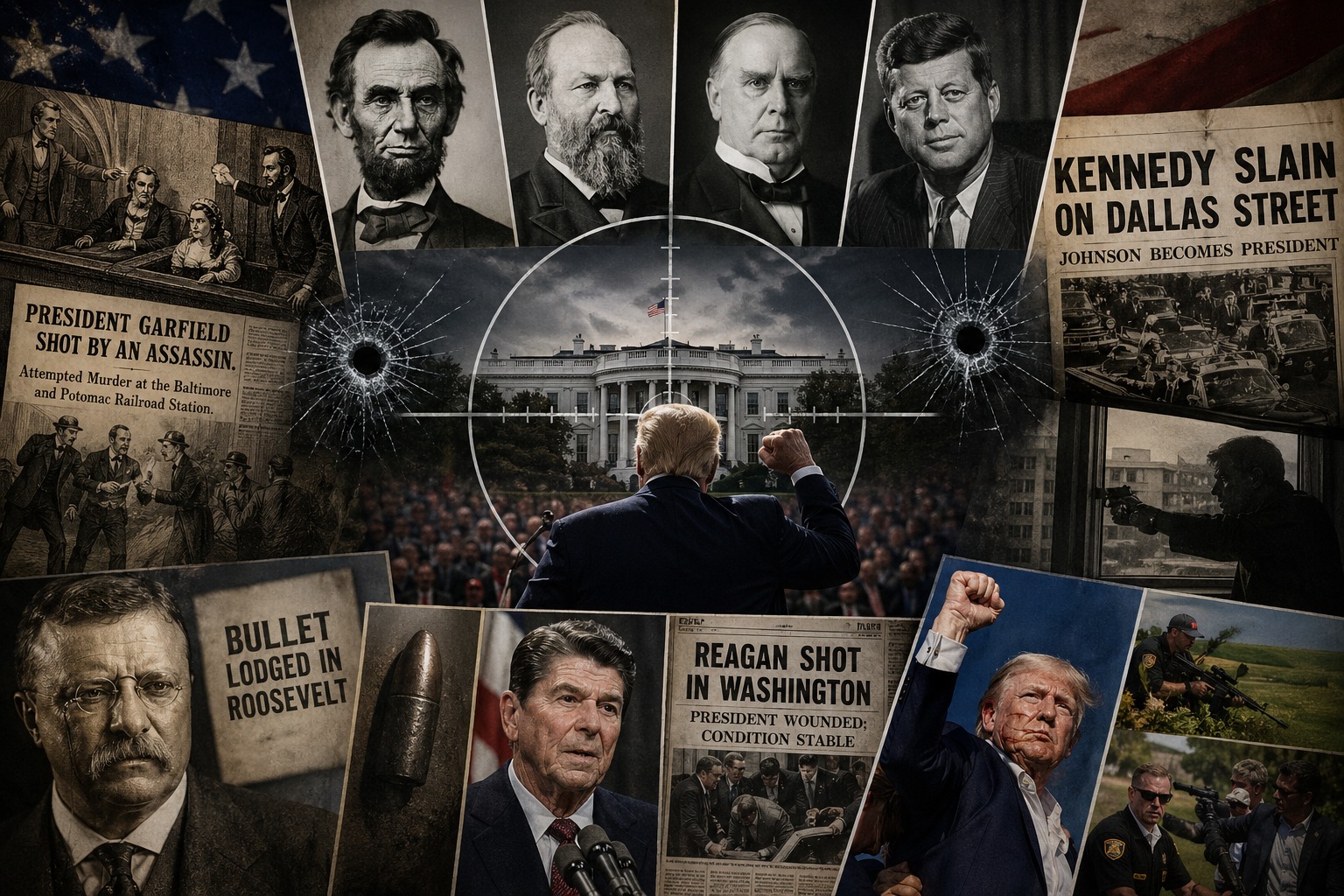
It was the first time a sitting U.S. president had been targeted at the White House Correspondents’ Association dinner. And it was the latest entry in a grim, two-century-long ledger—one that includes four murdered presidents, three wounded survivors, and dozens of failed plots that might have changed history.
With this incident, The Perspectives goes back to the US history and prepared for you a complete, fact-checked account of every direct assassination attempt on a United States president.
The four who fell
Four sitting presidents have been killed in office—three Republicans and one Democrat. Their deaths reshaped the nation.
Abraham Lincoln (Republican): On April 14, 1865 at the Ford’s Theatre, Washington, D.C —just five days after Confederate General Robert E. Lee surrendered at Appomattox—Lincoln and his wife Mary attended a performance of Our American Cousin. Booth, who had originally plotted to kidnap the president, changed his plan after attending a speech where Lincoln endorsed voting rights for Black men.
At approximately 10:15 p.m., Booth slipped into the presidential box, aimed at the back of Lincoln’s head, and fired. He then leaped onto the stage, breaking his leg on a flag draped over the railing, and shouted, “Sic semper tyrannis!” — “Thus always to tyrants.”
Lincoln was carried across the street to the Petersen House, where he died at 7:22 a.m. the next morning. Booth fled to Virginia, was cornered in a tobacco barn twelve days later, and was shot dead by Sergeant Boston Corbett.
Lincoln’s assassination triggered a twelve-day manhunt, the first presidential funeral train, and a brutal period of Reconstruction. Booth’s co-conspirators—including Lewis Powell, who nearly killed Secretary of State William Seward—were hanged.
James A. Garfield (Republican): Garfield had been president for only four months when Guiteau shot him on July 2, 1881, at the Baltimore and Potomac Railroad Station, Washington, D.C. The assassin, Charles J. Guiteau, believed he was owed a consular post in Paris for delivering a speech that (he claimed) had helped Garfield win the Republican nomination. After being repeatedly rejected, Guiteau decided God commanded him to remove the president.
The bullet from 442-caliber Webley revolver did not kill Garfield. The doctors did.
In the pre-germ theory era, physicians probed the wound repeatedly with unwashed fingers and unsterilized instruments, introducing rampant infection. Alexander Graham Bell rushed to Washington with an early metal detector but could not locate the bullet—partly because Garfield’s metal bedsprings confused the device.
Garfield lingered for 79 days, growing thinner and weaker, before dying on September 19. He had served just 200 days in office.
Guiteau recited poetry at his trial, argued that the doctors were the real killers, and was hanged on June 30, 1882.
William McKinley (Republican): At the Temple of Music, Pan-American Exposition, Buffalo, New York, President McKinley was greeting well-wishers in a receiving line on September 6, 1901. Leon Czolgosz, 28, approached with his right hand wrapped in a handkerchief—concealing the 32-caliber revolver. He fired twice at point-blank range.
The first bullet ricocheted off a button or medal. The second tore into McKinley’s stomach. As bystanders tackled and beat the assassin, McKinley called out, “Don’t let them hurt him.”
For eight days, McKinley appeared to recover. Then gangrene set in. He died on September 14. Theodore Roosevelt, vacationing in the Adirondacks, rushed to Buffalo and took the oath of office.
Czolgosz, who showed no remorse and declared he had “done his duty,” was executed in the electric chair on October 29, 1901. McKinley’s death directly led Congress to formally task the Secret Service with presidential protection.
John F. Kennedy (Democrat): November 22, 1963, remains the most analyzed assassination in American history. Kennedy rode in an open-top limousine with First Lady Jacqueline Kennedy and Texas Governor John Connally at Dealey Plaza, Dallas, Texas. At 12:30 p.m., shots rang out from the sixth floor of the Texas School Book Depository.
One bullet from a 6.5×52mm Carcano rifle struck Kennedy in the upper back, exited through his throat, and then struck Governor Connally. Another bullet struck Kennedy in the head, causing a catastrophic wound. He was pronounced dead at Parkland Memorial Hospital at 1:00 p.m.
Within two hours, Lee Harvey Oswald, 24, was arrested. Two days later, as police transferred him between jails, nightclub owner Jack Ruby shot and killed Oswald on live television.
The Warren Commission concluded Oswald acted alone. Public doubt has never fully subsided.
The wounded survivors
Three presidents (or former presidents) have been shot and survived—all Republicans, two of them struck while campaigning for a return to office.
Theodore Roosevelt (Republican – former president campaigning): This is the most extraordinary story in the annals of presidential survival.
On October 14, 1912, at the Milwaukee, Wisconsin, Roosevelt was running as a third-party “Bull Moose” candidate against incumbent William Howard Taft and Democrat Woodrow Wilson. As he left his Milwaukee hotel, John Schrank, a saloonkeeper stepped forward and shot him at close range.
The bullet tore through Roosevelt’s overcoat, his steel eyeglass case, and a folded 50-page speech—then lodged in his chest muscle. It did not penetrate his lung.
Roosevelt, a trained anatomist, coughed into his hand, saw no blood, and announced: “It takes more than that to kill a Bull Moose.”
He then ascended the podium and spoke for ninety minutes. His opening words: “I will make this speech or die, one or the other.”
Afterward, he saw a doctor. The bullet remained in his chest for the rest of his life. Schrank was declared insane and died in an asylum in 1943.
Ronald Reagan (Republican – sitting president): March 30, 1981. Reagan had been president for just 69 days. As he exited the Washington Hilton Hotel, Washington, D.C after a speech, John Hinckley, 25, fired wildly six shots in 1.7 seconds with 22-caliber revolver.
One bullet ricocheted off the side of the presidential limousine and struck Reagan under the left arm, puncturing a lung and stopping one inch from his heart. Press Secretary James Brady was shot in the head (paralyzed for life; his death in 2014 was ruled a homicide). Police officer Thomas Delahanty and Secret Service agent Timothy McCarthy were also wounded.
As agents shoved Reagan into the limousine, he complained of difficulty breathing. At the hospital, he famously told the surgical team: “I just hope you’re all Republicans.” One doctor replied: “Today, Mr. President, we’re all Republicans.”
Reagan recovered and returned to the White House twelve days later. Hinckley was found not guilty by reason of insanity and was fully released from court oversight in 2022.
Donald Trump (Republican – former president campaigning): Trump is the only person in American history to survive two separate assassination attempts in a single election cycle.
First attempt (July 13, 2024): At a rally in Butler, Pennsylvania, 20-year-old Thomas Crooks fired multiple rounds. One bullet grazed Trump’s right ear, drawing blood as he ducked. A spectator—former fire chief Corey Comperatore—was killed shielding his family. Two others were wounded. Secret Service sharpshooters killed Crooks at the scene.
Second attempt (September 15, 2024): At Trump’s golf course in West Palm Beach, Secret Service agents spotted a gunman’s rifle barrel protruding from shrubbery. They opened fire before Ryan Routh could take aim at the former president. Routh fled, was apprehended, and later sentenced to life in prison.
Trump’s response after the Butler shooting: “It’s a dangerous profession” a sentence he repeated after the last night’s attempt.
What happened last night?
Last Saturday night, when 31-year-old Cole Tomas Allen of Torrance, California, carried a disassembled long gun—described as a shotgun—into the Washington Hilton Hotel, the same venue where Ronald Reagan was shot in 1981. According to official statements and eyewitness accounts, the hotel's main entrance lacked metal detectors, with security screening occurring only at the ballroom doors. Allen, a registered hotel guest, entered a "makeshift room" or service alcove containing beverage carts—an unguarded space near the ballroom entrance—where he removed the firearm parts from his bag, assembled the weapon, and stepped out firing. He discharged between five and ten shots, specifically targeting a Secret Service agent stationed at the magnetometer. The agent was struck in the chest, but his bulletproof vest stopped the round. Secret Service agents returned fire and apprehended Allen at the scene.
Inside the ballroom, President Trump, First Lady Melania Trump, and Vice President JD Vance were seated at the head table. As shots rang out, agents rushed them offstage. Attendees dove under tables.
“We could smell the powder. We immediately dove to the ground,” Al Jazeera producer Chris Sheridan told reporters. “It was directly behind me.”
Within an hour, President Trump addressed the nation from the White House briefing room, praising the Secret Service: “One officer was shot, but saved by his bulletproof vest. The vest did the job.”
The dinner was canceled and will be rescheduled within 30 days.
As of Sunday morning, Allen is in custody facing felony charges. No motive has been officially released.
The one who never got close
Not every attempt ends in blood; some fail by inches, and some by pure delusion. In 1835, Richard Lawrence fired two pistols at Democrat Andrew Jackson in the Capitol rotunda—both misfired, and Jackson beat him with a cane. In 1933, Giuseppe Zangara fired five shots in Miami, missing Democrat Franklin D. Roosevelt but killing Chicago Mayor Anton Cermak. In 1950, two Puerto Rican nationalists attempted to storm Blair House, where Democrat Harry S. Truman was staying; a gunfight killed one assailant and a White House police officer, while Truman watched from an upstairs window. In 1975, Republican Gerald Ford survived two attempts in just seventeen days: Lynette "Squeaky" Fromme, a Charles Manson follower, drew a pistol that did not fire, and Sara Jane Moore fired once and missed before being grabbed by a former Marine. In 2005, a live hand grenade was thrown at Republican George W. Bush in Tbilisi, Georgia, but the handkerchief wrapped around it prevented the firing pin from deploying. In 2011, Oscar Ortega-Hernandez fired an AK-47 at the White House, missing Democrat Barack Obama entirely. And in 2023, Sai Kandula rammed a truck into a White House barrier, saying he planned to kill Democrat Joe Biden and "take over."

Comments (0)
No comments yet. Be the first!
Leave a Comment
Your comment will be reviewed before publishing.