
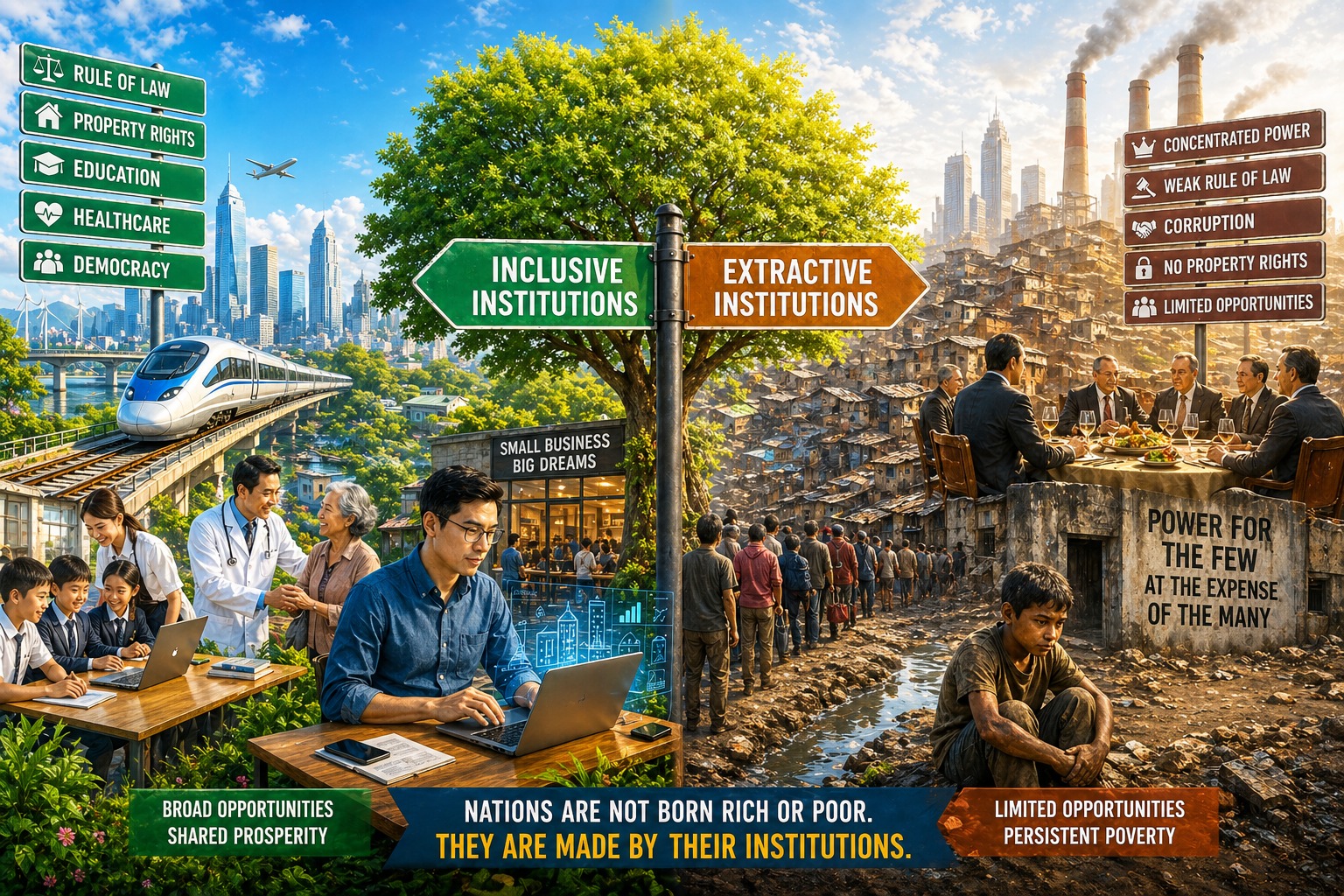

A decade after its publication, Why Nations Fail by Daron Acemoglu and James Robinson offers a strong rebuttal. Its central claim is simple: national wealth or poverty is mainly determined by institutions—the political and economic rules that shape incentives and power.
To explain inequality, the authors argue, one must focus not on geography or culture, but on who holds power and how it is used.
The book begins with a striking comparison: the twin cities of Nogales. One is in Arizona, USA; the other in Sonora, Mexico. They share history, culture, and geography, yet incomes differ dramatically—households in the US side earn about three times more.
The difference, the authors argue, is the border itself.
On the US side, institutions are inclusive: secure property rights, functioning infrastructure, legal enforcement of contracts, public services, and democratic accountability. On the Mexican side, institutions are more extractive, concentrating wealth and opportunity in the hands of a narrow elite. The result is not only income disparity but also differences in health, safety, and life expectancy.
The authors frame their theory around two types of institutions, inclusive and extractive.
Inclusive institutions enable prosperity. They protect property rights, enforce law equally, provide public services, and allow entrepreneurship. This environment enabled figures like Bill Gates and Thomas Edison to innovate and grow businesses without fear of arbitrary seizure or political interference.
Extractive institutions produce poverty. They are designed by elites to transfer wealth from the majority to the few. Examples include monopolies built through political ties or regimes where the state controls the economy and suppresses markets, as seen in North Korea.
A key insight is that these systems reinforce themselves. Inclusive institutions create a virtuous cycle: broader prosperity leads to broader political participation, which strengthens inclusive rules. Extractive institutions create a vicious cycle: elites use wealth to maintain political control, which allows further economic exploitation.
A central argument of the book is that poverty persists not due to ignorance, but because elites deliberately preserve extractive systems that benefit them.
This is tied to “creative destruction,” where innovation replaces old systems. Elites often resist this process because it threatens their power. For example, when inventor William Lee demonstrated a knitting machine to Queen Elizabeth I, she refused to approve it, fearing unemployment and instability.
Similar patterns appear in history: rulers blocking railways due to fear of unrest, or Chinese emperors dismantling naval fleets to avoid foreign influence and internal disruption.
History is not destiny, but it matters
The authors argue that outcomes depend on “critical junctures”—major disruptions that reshape institutions.
They illustrate this using the Black Death in Europe. In Western Europe, labor shortages strengthened peasants’ bargaining power, weakening feudalism and increasing freedom. In Eastern Europe, elites responded by tightening control, creating harsher systems of serfdom that locked in long-term poverty.
They also describe a global “reversal of fortune.” In 1500, regions in the Americas such as the Aztec and Inca empires were wealthy and organized, while North America was less developed.
European colonization reversed this. Dense, resource-rich regions were turned into extractive colonies relying on forced labor, while North America’s settler colonies developed more inclusive institutions due to lack of exploitable populations.
Today’s relevance
The framework is applied to modern cases.
China’s rapid growth is interpreted as “growth under extractive institutions.” Market reforms coexist with strong political control. While this enables fast development, the authors argue it limits long-term innovation because true creative destruction is constrained.
The Arab Spring is seen as a response to extractive systems where elites monopolized political and economic power. However, the book warns that revolutions often replace one elite with another unless institutions fundamentally change.
The hardest lesson
A major implication is for foreign aid and development policy. If poverty is rooted in power structures, then aid alone cannot solve it and may even strengthen authoritarian regimes.
Historical cases such as Mobutu’s Congo show how foreign funds can reinforce elite control rather than improve public welfare.
True development, the authors argue, comes from political change—often messy and conflict-driven—where power becomes more broadly distributed. Examples include the Glorious Revolution in England, the founding of the United States, and Japan’s Meiji Restoration.
Why Nations Fail presents a political explanation of poverty: nations are rich or poor because of how power is organized. Poverty is not inevitable or natural; it is created and sustained by institutions shaped by those who benefit from them.
Ending poverty, therefore, requires not just better policies or aid, but building systems where power is widely shared and no group is above the law.



Comments (0)
No comments yet. Be the first!
Leave a Comment
Your comment will be reviewed before publishing.